
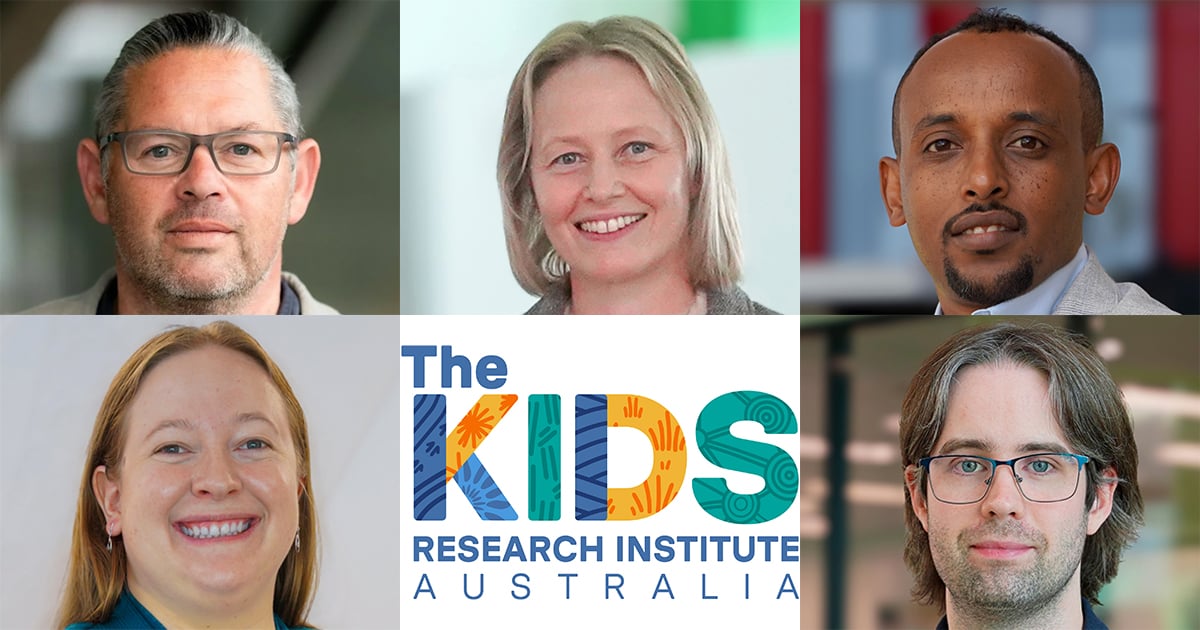
Five researchers from The Kids Research Institute Australia have secured prestigious National Health and Medical Research Council (NHMRC) Investigator Grants, earning five years of funding to advance research tackling some of Australia's most pressing child health challenges.
Professor Alex Brown, Associate Professor Shannon Simpson, Associate Professor Kefyalew Alene, Dr Katherine Landwehr and Dr Richard Lee were among 234 outstanding researchers nationwide awarded Investigator Grants in the latest funding round.
Federal Minister for Health Mark Butler today announced more than $430 million in NHMRC Investigator Grants, supporting Australia's leading researchers at every career stage to pursue innovative research with the potential to improve health outcomes both nationally and globally.
Professor Alex Brown, Head of the Indigenous Genomics team based in Adelaide and Professor of Indigenous Genomics at ANU, has been awarded $3 million to use precision medicine to reduce Indigenous health inequalities. His unique program - built on large-scale, longitudinal research - will develop a more comprehensive understanding of the environments that drive chronic disease and conversely, preserve wellbeing. It will shift personalised medicine toward the explicit reduction of chronic disease in Indigenous Australians by outlining the major priorities in personalised medicine for Indigenous Australians, the necessary steps required to deliver meaningful benefit, and the articulation of pathways to reduce inequality. It will establish the foundations on which Indigenous Australians can benefit from the health promoting and preventative, diagnostic, curative, and scientific potential of genomics.
Associate Professor Shannon Simpson, Strong Beginnings Theme Head and Associate Professor at Curtin University, will receive a $2.6 million to improve the lifelong lung health of infants born prematurely. Her comprehensive program of work will detect, arrest and reverse prematurity associated lung disease. The program comprises three integrated research streams: defining lifetime lung-health trajectories via the global Prematurity’s Effects on the Lungs In Children and Adults Network (PELICAN) Clinical Research Collaboration and dataset; pinpointing biomarkers of disease progression using proteomics; and determining whether cutting-edge intervention, trained immunity vaccine Bactek (MV-130) alters lung-health trajectories in preterm born infants. Together, these studies will generate the knowledge, tools, and strategies needed to transform outcomes for people born preterm and reduce the burden of COPD-D.
Associate Professor Kefyalew Alene, Head of the Geospatial and Tuberculosis team and Associate Professor at Curtin University, has been awarded $1.6 million for geospatial analytics to accelerate global tuberculosis elimination efforts. Building on his team’s existing internationally recognised work on TB and drug-resistant TB, his five-year research program aims to establish a global TB spatial data infrastructure platform, produce high-resolution global maps of TB burden (including emerging local drug resistance hotspots), and optimise the effectiveness of TB interventions by designing innovative approaches that accelerate progress toward achieving End TB targets. By providing policymakers and health providers with detailed, actionable geospatial data through a publicly accessible TB data platform and high-resolution maps, this research will empower targeted interventions, enhance resource allocation and program efficiency, and substantially accelerate progress toward global TB elimination.
Dr Katherine Landwehr, Senior Research Officer with the Respiratory Environmental Health team with affiliations with The University of Western Australia and Curtin University, has been awarded $697,000 to research the critical effects of inhaled pollution on children. Her research program will define the toxic health impacts of emerging sources of inhaled pollution using both healthy and diseased paediatric in vitro and in vivo pre-clinical exposure models; comprehensively characterise the physico-chemical properties of the different exposure types, such as particle size, chemical contaminants and toxic gas concentrations; and use multivariate and Bayesian statistical analysis to link each inhaled pollutant with the resulting health impact, allowing for the development of a mathematical screening model that can predict health effects of all inhaled pollution exposures. The outcomes of this work will accelerate assessment of the potential health effects of new pollution sources before they become a public health crisis.
Dr Richard Lee from Curtin University and Honorary Team Member in the Synthetic Biology and Gene Therapy team at The Kids has been awarded $697,000 to research new treatments for children with mitochondrial diseases. Mitochondrial diseases are a group of inherited metabolic disorders that impact multiple organ systems for which there is currently no cure. Dr Lee will investigate lipid-based small molecules as treatment strategies for mitochondrial diseases. He will employ multiomics analyses combining transcriptomics, proteomics, lipidomics, metabolomics, and glycomics to holistically characterise how enhancing lipid metabolismalters and rescues the global cellular environment of mitochondrial disease. His research will also develop clinical models of mitochondrial diseases to validate the efficacy of the small molecules in vivo and characterise their impact across multiple organ systems.
Click here for more information on the funding announced by Minister Butler today.
Professor Brown’s grant will be administered through the Australian National University; Associate Professor Simpson’s; Associate Professor Alene’s and Dr Lee’s grants will be administered by Curtin University, and Dr Landwehr’s grant will be administered through The University of Western Australia.
First published Wednesday 29 July 2026.
View all news articles