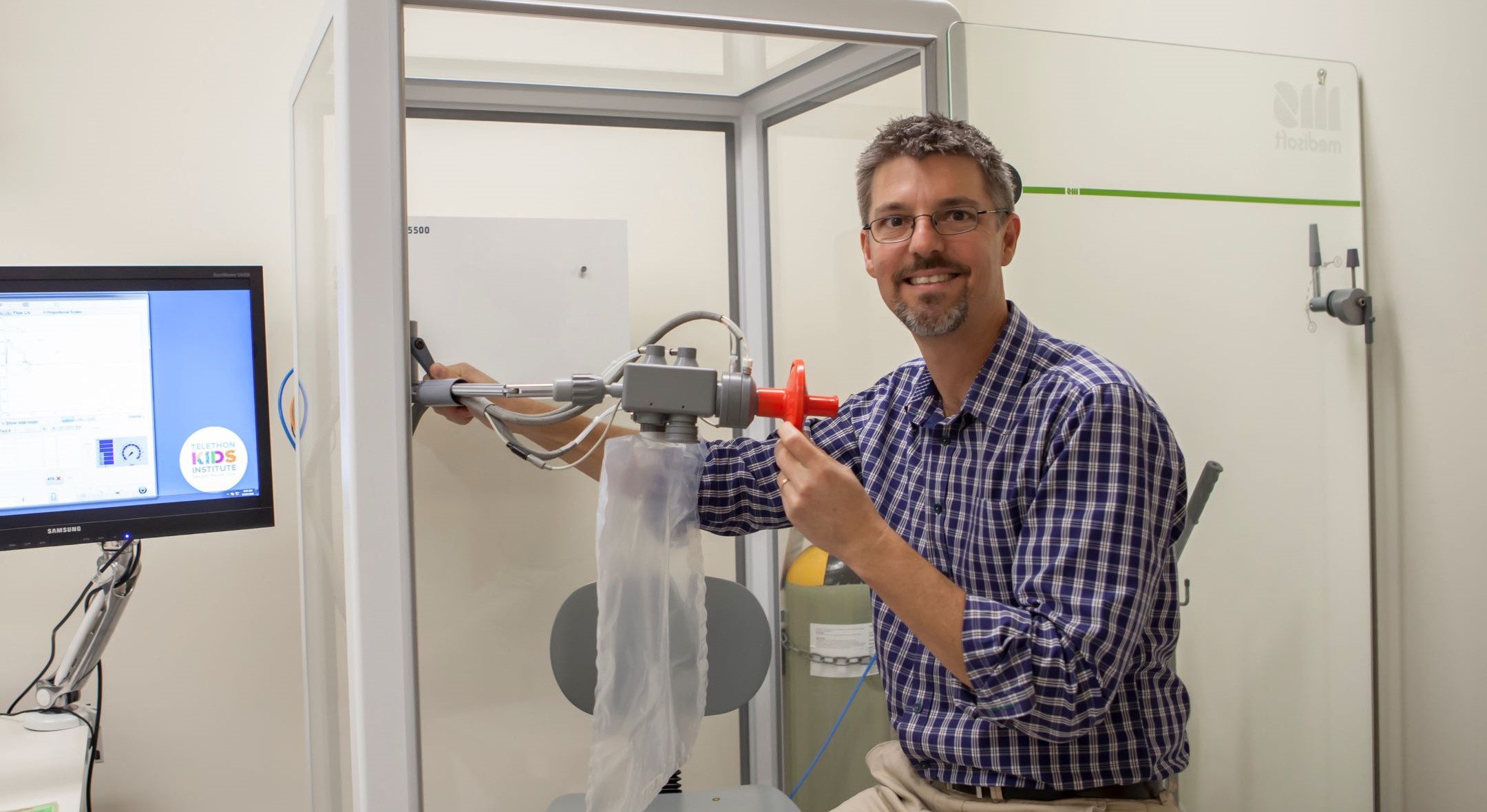
Professor Graham Hall with lung function testing equipment
A global network of researchers and clinicians, co-led by The Kids’ Professor Graham Hall, has transformed international best practice in identifying low lung function and diagnosing and treating lung disease.
Assessments of lung function are a key plank in the diagnosis and management of lung disease, but for decades it was common for the same lung function result to be interpreted differently, depending on the laboratory where the test was done.
A lack of standardisation and wide discrepancies in what was defined as the ‘normal range’ of lung function values often led to misdiagnosis – with significant consequences for individuals and communities.
Determined to address this issue, in 2008 Professor Graham Hall and international colleagues established the Global Lung Function Initiative (GLI), a global network of researchers and clinicians which since has grown to more than 400 members – all working collaboratively and altruistically with one another and with industry partners.
Led by Professor Hall alongside Associate Professor Sanja Stanojevic from Dalhousie University in Halifax, Canada, the GLI Network set out to produce a standardised set of global lung function reference ranges – a comparison of a patient’s lung function to the general population – to inform clinical care. Until recently, reference ranges rarely included both children and adults, and included only a limited number of ethnicities.
“In a clear demonstration of research being translated into practice, the Network has now developed reference values for routine lung function testing that provide a standardised approach to improve the way in which lung function tests are interpreted around the world,” Professor Hall said.
The GLI-developed reference ranges are now considered the gold standard for international clinical practice and have been endorsed by national and international respiratory societies and embedded in international and Australian clinical practice guidelines.
“The GLI Network directly spans nearly all aspects of clinical research and global respiratory medicine and has become the largest resource for reference values for routine lung function testing ever assembled,” Professor Hall said.