
Search
Showing results for "aboriginal respiratory"

A decade long partnership with Wesfarmers Ltd. and the Wesfarmers Centre of Vaccines and Infectious Diseases has led to world-class paediatric research and important collaborations fuelling the Centre’s trajectory towards easing the burden of infectious diseases.
The Staphylococcus aureus Network Adaptive Platform (SNAP) trial is a multifactorial Bayesian adaptive platform trial that aims to improve the way that S. aureus bloodstream infection, a globally common and severe infectious disease, is treated. In a world first, the SNAP trial will simultaneously investigate the effects of multiple intervention modalities within multiple groups of participants with different forms of S. aureus bloodstream infection.
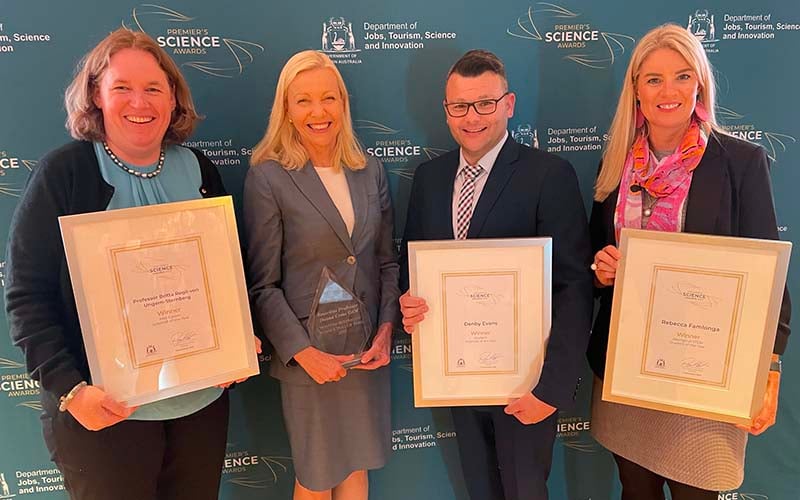
Three outstanding researchers have won 2023 Premier’s Science Awards, with another inducted into the prestigious WA Science Hall of Fame.
Asha Tom Bowen Snelling BA MBBS DCH FRACP PhD GAICD FAHMS OAM BMBS DTMH GDipClinEpid PhD FRACP Head, Healthy Skin and ARF Prevention Head, Infectious
Otitis media (OM) is a common childhood disease characterised by middle ear effusion and inflammation.
Adaptive clinical trials have designs that evolve over time because of changes to treatments or changes to the chance that participants will receive these treatments. These changes might introduce confounding that biases crude comparisons of the treatment arms and makes the results from standard reporting methods difficult to interpret for adaptive trials. To deal with this shortcoming, a reporting framework for adaptive trials was developed based on concurrently randomised cohort reporting.
Despite the volume of accumulating knowledge from prospective Aboriginal cohort studies, longitudinal data describing developmental trajectories in health and well-being is limited.
This chapter describes the challenges experienced by Aboriginal people in their efforts to negotiate Australian society

Our team aims to better understand how the immune response to immune challenges, such as viral infections can influence the risk of developing asthma or autoimmune disease.
To examine rates and predictors of 7-day readmission in infants hospitalised before 3 months of age with infectious and non-infectious conditions. A retrospective population-based data-linkage study of 121 854 infants from a 5-year metropolitan birth cohort (2008-2012). Cox proportional hazard models were used to examine associations between infant and maternal factors with 7-day readmission.