
Search
Showing results for "lung disease preterm"

Our AussieRett team recently visited Melbourne, Australia for the IASSIDD 15th World Congress.
Vaccine Trials Group with Sir Charles Gairdner Hospital is conducting a trial of a vaccine against Clostridium difficile infection (CDI) in at-risk individuals.

ORIGINS is on the lookout for our Long COVID Study. As we enter a new wave of COVID in the community, we would like to remind participants to 'think
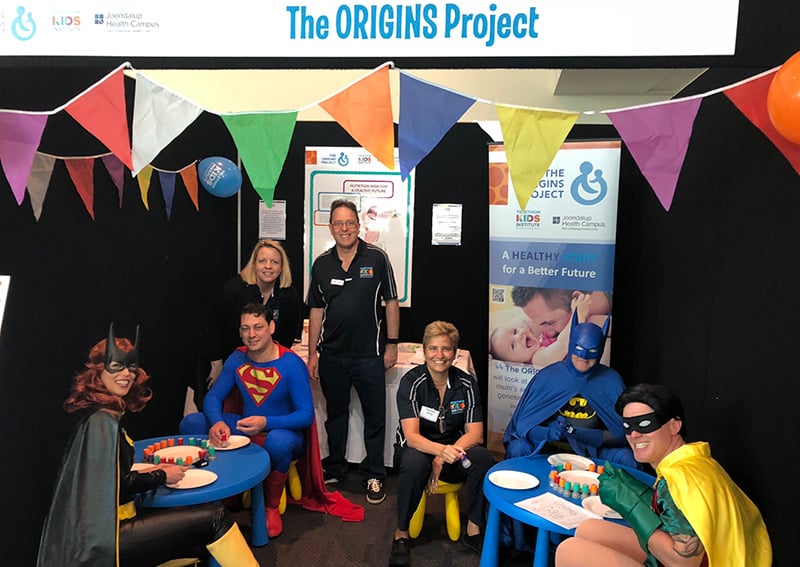
Over the weekend, ORIGINS staff were out in force in the phone rooms and in our ORIGINS Project booth at the Beneficiaries Expo at the Perth Convention and Exhibition Centre.
Human movement drives spatial transmission patterns of infectious diseases. Population-level mobility patterns are often quantified using aggregated data sets, such as census migration surveys or mobile phone data. These data are often unable to quantify individual-level travel patterns and lack the information needed to discern how mobility varies by demographic groups. Individual-level datasets can capture additional, more precise, aspects of mobility that may impact disease risk or transmission patterns and determine how mobility differs across cohorts; however, these data are rare, particularly in locations such as sub-Saharan Africa.

Three hundred and fifty million people live with an undiagnosed disease worldwide and three quarters of them are children.
Previous research has shown that immune development during the first week of life, i.e. ontogeny, is progressive, consistent and robust, involving large numbers of differentially expressed genes at each sampled time point.
Malaria remains a leading cause of morbidity and mortality and is responsible for over 0.5 million annual deaths globally. During the first two decades of this century, scale-up of a range of tools was associated with significant reductions in malaria mortality in the primary risk group, young African children.
The World Health Organization recommends perennial malaria chemoprevention (PMC), generally using sulfadoxine-pyrimethamine (SP) to children at high risk of severe Plasmodium falciparum malaria. Currently, PMC is given up to age two in perennial transmission settings. However, no recommendation exists for perennial settings with seasonal variation in transmission intensity, recently categorized as 'sub-perennial'.
Multiple sclerosis (MS) demonstrates a latitude gradient in prevalence and severity, implicating ultraviolet B (UVB) exposure and photoimmune mechanisms in disease risk and progression. While narrowband (NB)-UVB phototherapy has long stabilized inflammation in dermatology, its systemic immunomodulatory effects in MS remain incompletely defined.