
Skip to content

1.1 Building good communication

Good communication is one of the greatest strengths you can have as a FIFO family.

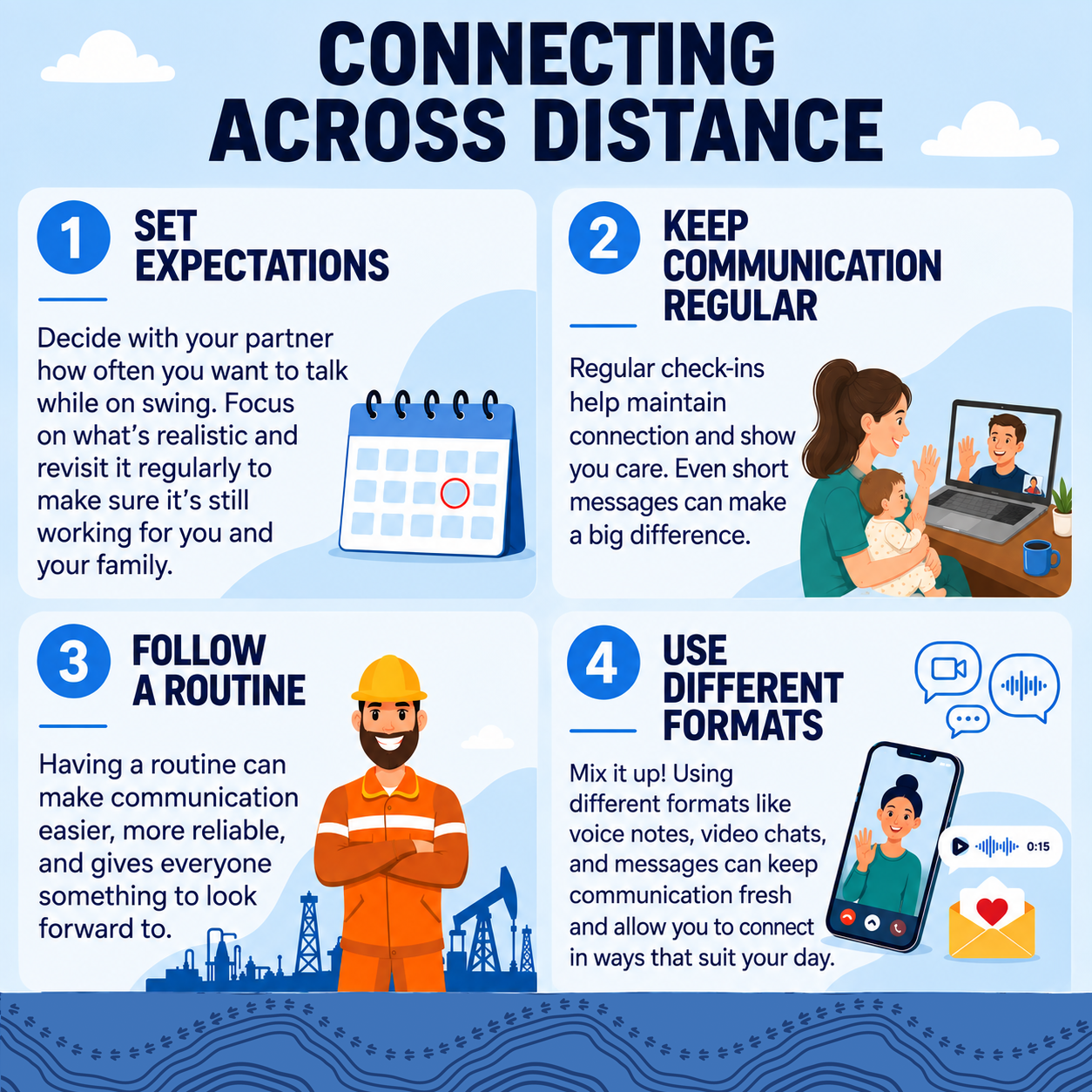
Communicating well as a family helps parents and children stay connected even across distance. Good communication involves being open, consistent, and accessible. Despite the challenges of FIFO life (like time apart, fatigue, and busy routines), families can develop creative, flexible, and resilient ways to stay close. This section shares practical tips and real-life examples of how to build on your communication skills.

Communication strategies - managing emotions and relationships

Communication can feel harder when you’re tired, frustrated, or when things get misunderstood. You can make it easier by noticing how you and your partner are feeling and using strategies that support better communication. Below some parents share their experiences of developing stronger communication skills.

Story one

Miranda (FIFO parent)

man talking with woman

"Tell your partner when you’ve had a sh*t day"

"When you're away, you don't know what's happened during each other's day. It's learning to communicate the fact that you're having a challenging time and that you don't feel right. That means you're not wondering at the other end of the phone, what have I done to you? You think you're shitty with each other, but you're really not. You just have other stuff happening. It's about being able to communicate when you're not feeling great and why."

Conversation starter

“I’m pretty wiped today—long shift. It’s not about us. I might be quiet tonight, but I’d still love to hear your voice.”

Reflection time

  • FIFO parents: If you imagine yourself in your partner’s shoes, at home with the kids, what might they be thinking if they don't hear from you, or if you seem down?
  • Non-travelling parents: When was the last time you were frustrated about something at home, but didn’t talk about it with your partner? How can you approach it differently next time? 

Top tip

Don’t keep your emotions bottled up. Being open about how you are feeling can help avoid misunderstanding each other’s mood or silence. 

Story two

Jessie (non-travelling partner)

woman writing in a book

“Sometimes you just need to table things for when you’re together”  

"You learn to adapt how you communicate over time. I’ve found we just need to set aside some conversations for when he’s home. We’re not going to get anywhere talking about issues with the kids or something with our relationship when he’s tired on phone. It’s not fair on him in his environment, it’s not fair on me, in my environment".

Conversation starter

“There's something that I've been thinking about, but it will be easier to discuss when you’re home. It isn’t anything to stress about. Can’t wait to see you when you’re back.” 

Reflection time

Workers and partners at home: How do you currently decide when to have important conversations, and what changes could help you feel more heard and less stressed?

Top tip

Leave big or important conversations for when both partners have time and energy. If you need to have a discussion or are frustrated by something, talk about it before a swing so it doesn’t grow into a bigger issue. 

Story three

Jessie (non-travelling partner)

man and woman talking

“Don’t make it a competition”

“One of the issues is making sure your partner doesn’t feel like you’re having a competition for who has it the hardest. I’ll prattle off all the things I must do: ‘I have to finish work early, pick up my daughter and cook dinner’. I’ll say this to my partner and he'll be like, ‘well, I worked 12 1/2 hours. I got up at 4am, and then my only down time was a couple of beers at the end. And then I went and sat in a box to go to sleep’. It's not easy what they do, but it’s hard for everyone in FIFO families. Don’t be competitive about it, because it’ll just make things worse”.

Conversation starter

“I know we’re both dealing with a lot. Instead of comparing who’s got it harder, how about we just share what’s been tough for each of us and figure out how we can support each other?”

Reflection time

FIFO parents and non-travelling parents: When stress builds up, how do you and your partner acknowledge the different pressures you each face? What could you do differently to better support each other when life feels overwhelming?

Top tip

Avoid turning conversations into a “who has it harder” competition. Instead, acknowledge each other’s challenges and discuss how you can support one another. 

Further information and resources

The information in this section is informed by research and evidence-based resources. The following resources provide additional information and practical strategies for communicating effectively in relationships: 

Things to remember

  • Be open and aware of your emotions: Share how you’re feeling honestly with your partner to avoid misunderstandings.
  • Time conversations carefully: The timing of a conversation can have a big impact on how they go. Save big conversations for when you both have the time and energy.
  • Avoid comparing who has it harder: Acknowledge each other’s sacrifices and look for ways to support each other instead.

What's next?

In the next section, you'll learn about how to approach long-term and short-term planning in FIFO relationships.

Life on rotation

Navigation