
Skip to content

1.2 Short-term and long-term planning

Your planning can influence how well you can take advantage of the positives that come with FIFO, including more quality time at home and financial security, as well as how well you cope with some of the challenges.

Planning in FIFO families often needs ongoing communication and work from both partners. In this section, we will share strategies and activities for managing day-to-day planning like managing your weekly schedule to more long-term planning like changing your working arrangements.

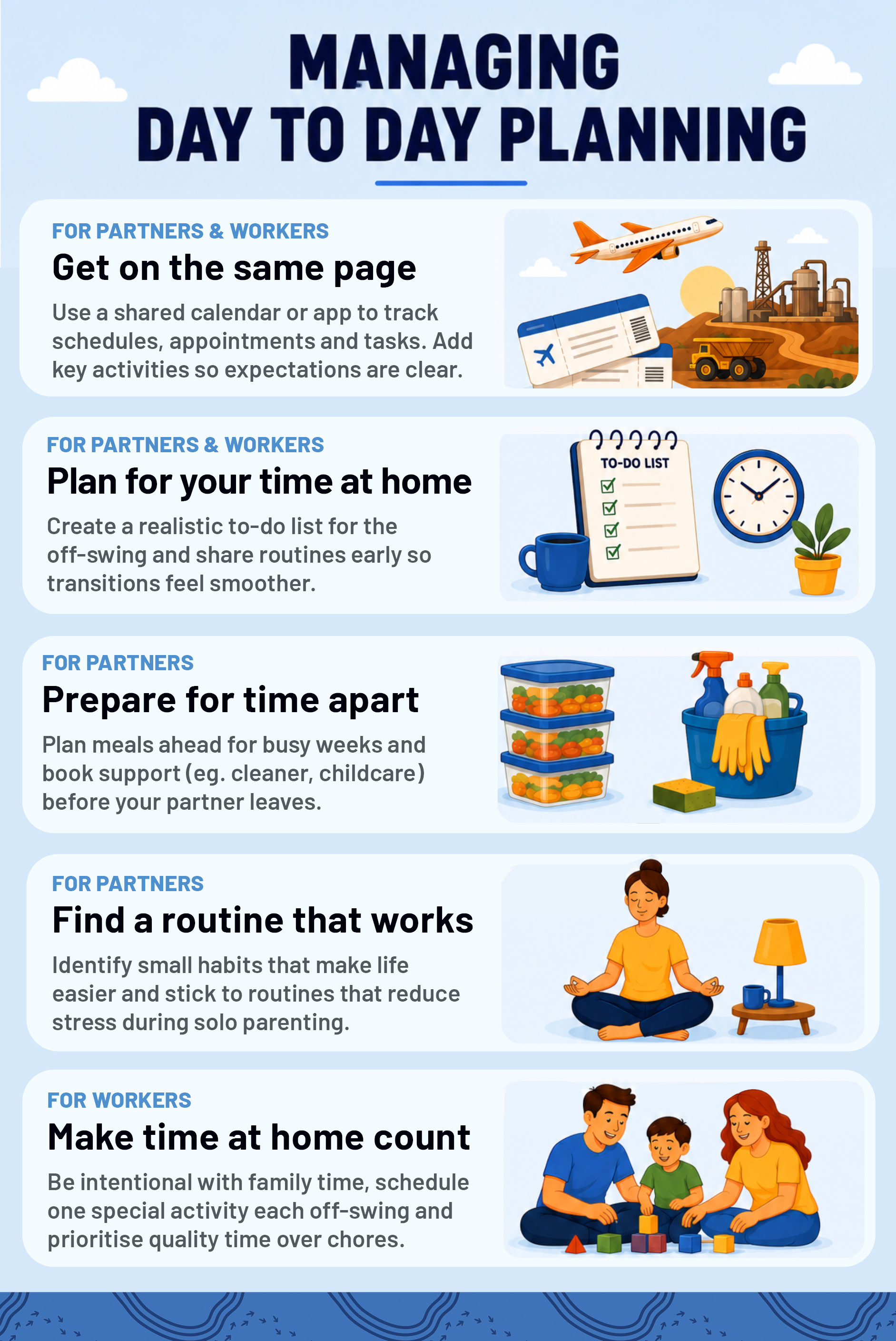
Managing day-to-day planning

Long-term planning

Alongside your day-to-day planning, before or while working FIFO you may have a more long-term plan about finances, family goals, career paths, and future work arrangements. Making shared decisions can be difficult, particularly when partners have different concerns or priorities. The tips and stories below share strategies that can help couples make these decisions together.  

Tips for planning and decision making in FIFO relationships

1. Start with shared values

Identify what matters most to both of you (e.g., family time, financial security, career progression) and use these values to guide your decisions and planning. 

2. Communicate openly and regularly

Making decisions and plans isn’t a one-off event. Talk regularly about your goals or concerns, especially when things change. Choose the right time have these conversations such as during home swings.  

3. Plan for flexibility 

Life changes— kids, your health, roster types —so revisit plans regularly. Agree on how you’ll adapt if circumstances change.

4. Use collaborative problem-solving

Weigh up the pros and cons of a decision with your partner and brainstorm different options without judgement. 

5. Set milestones 

For some people, FIFO is not forever. Decide on times when you want to review your plan or goals (e.g., every year) and consider triggers for change (e.g., child starting school, mortgage paid off, future career goals).

Planning strategies – Learning from others' experiences

Throughout your time in FIFO, you’ll make decisions as your work and home-life change. These stories show how couples have approached planning and decision-making. We outline key takeaways, reflection questions and then action steps to guide how you might apply what you’ve learnt. 

Story one

Miranda (FIFO Parent)

man talking with woman

Making the decision to work FIFO

“Starting FIFO wasn't something I took on lightly. It was a shared decision. We weighed up the pros and cons. My partner has a good paying job, but it's still not what we need to achieve our five-year goal of financial security. Working FIFO would allow us to achieve that goal a lot faster. Our discussions were mostly about the kids. Everything from who’s going to get my younger children to daycare and primary school, who would do pick-ups?  And a conversation around whether he would be happy for me to do this role in terms of being away for so long. Could he cope?  A big mixture of things”.

Key takeaway

Weigh up your financial and career goals against potential challenges and your family’s needs. Shared decision-making upfront can reduce stress later.

Reflection time

FIFO parents and non-travelling parents: Revisit the conversations you had before starting FIFO, what’s working, what’s harder than you expected, and what might need adjusting now?

Action step

Choose one thing that is no longer working and talk to your partner about how you can approach it differently.


Story two

Jarrad (FIFO Parent)

woman writing in a book

Changing working arrangements for the future 

It was probably the second year into having a child, and I was on a two-and-one roster. I remember the day my partner called me up and said, “I can’t have you being away for that long. It’s just not working.” And that’s what triggered me to move to a shorter roster. At first, I was concerned about the drop in money and the turnaround time being too fast. But once you’re on the roster, it’s actually a really good balance. And making the choice between a happy family and having to adjust your lifestyle to match your new pay, it was an easy decision in the end.

Reflection time

  1. For FIFO parents: What changes in your life might tell you it’s time to review your roster?
  2. For non-travelling parents: What signs tell you that you need more support at home, and how can you talk about this with your partner?

Top tip

Major life changes are a good time to reassess FIFO arrangements and consider adjustments at work or at home, to keep things manageable —such as trialling a shorter roster, job sharing or organising extra childcare.

Action step

Choose one current or upcoming life change and find a time to talk with your partner and about whether your current roster still supports your family’s needs.  

Examples: A new baby, a child starting school, partner changing jobs, or increased stress at home. 

Story three

Emma (Non-Travelling Parent)

man and woman talking

Having a long-term goal

"I think having that common end goal is key. You need to know why you're doing it. We've been together for over a decade and he's worked away for most of that. He's missed out on birthdays and Christmas. It's not for everyone, but for us it's worked for so long because we know what we want to achieve and what our end goal is. Even if the end goal changes, it's important to keep revisiting why we're doing this and why it's important for our family."

Reflection time

FIFO parents and non-travelling parents: How are you tracking towards your shared end goal, and what trade-offs—like missed birthdays or holidays—still feel acceptable or need rebalancing?

Top tip

Having a shared long-term goal (like paying off a mortgage or saving money for your child’s education) can help you feel united and stay motivated, especially during challenging times.

Action step

Write the big goal you want to achieve through FIFO. Then break it down into manageable steps, to keep you on track. Setting goals that are specific, realistic, relevant to you and time bound, can make them easier to achieve. Breaking big goals into smaller six‑month goals can make them easier to reach and adjust if things change. 

Further information and resources

The information in this section is informed by research and evidence-based resources. The following resources provide additional information and practical strategies for different aspects of planning in relationships:

Things to remember

  • Plan together and revisit regularly: FIFO planning works best when both partners communicate openly and check in as circumstances change.
  • Keep your shared goals in focus: Having a clear reason for doing FIFO can help guide decisions and maintain motivation during challenging periods. 
  • Be flexible and adapt when needed: Major life changes may mean adjusting rosters, support arrangements, or long-term plans to better meet your family's needs. 

What's next?

In the next module, you'll learn how FIFO workers can keep connected with their children while away. 

Life on rotation

Navigation